

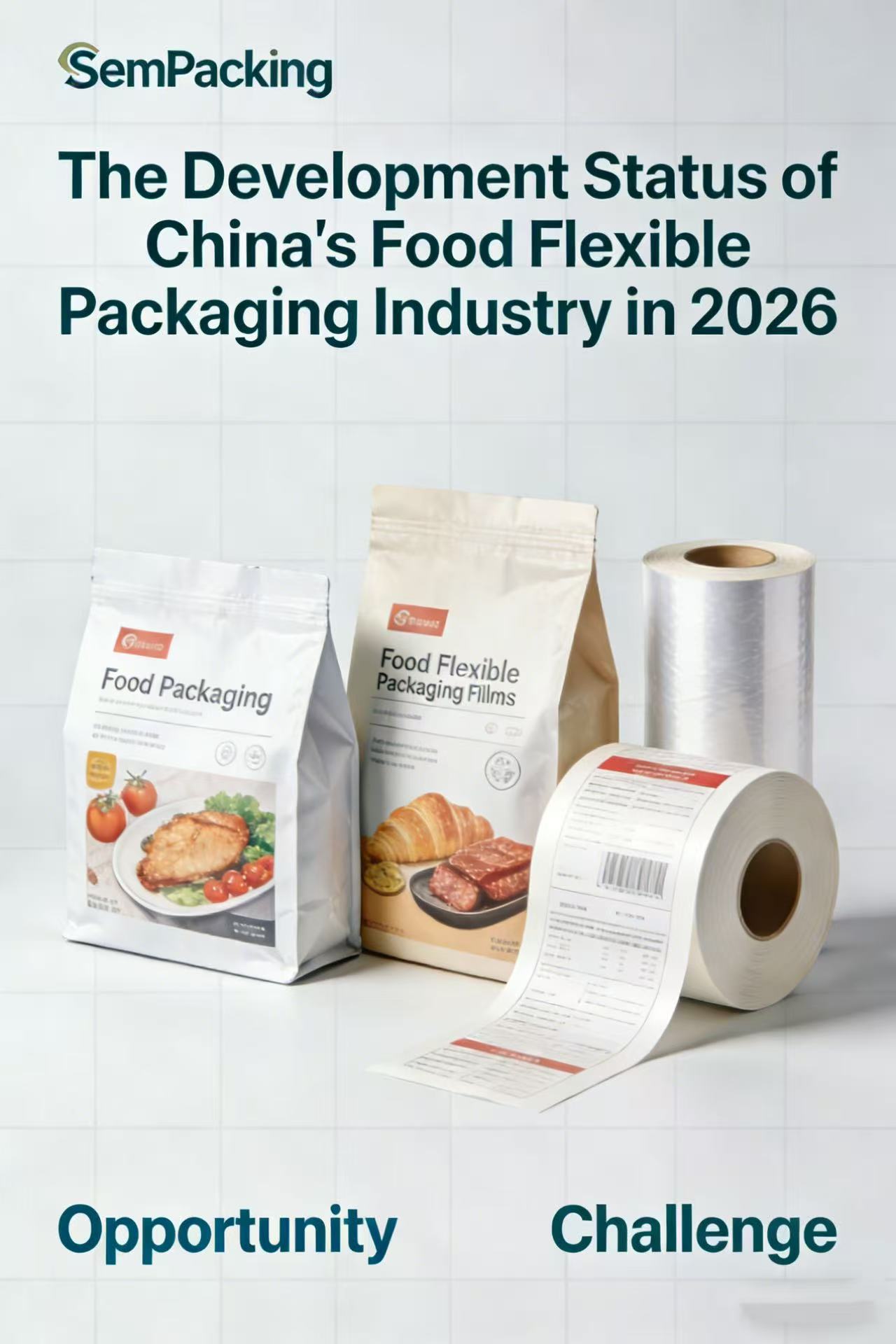
In 2026, China’s food flexible packaging industry is stepping into a critical stage of high-quality development, with its growth driver shifting from quantity expansion to quality improvement. Driven by policy guidance, consumption upgrading and technological innovation, the industry is accelerating its evolution towards greenization, intelligence and intensification, showing a distinctive development pattern of steady growth and structural optimization.
In terms of market scale, the industry maintains a steady growth momentum. It is estimated that the market size of China’s food flexible packaging will reach RMB 301.8 billion in 2026, with a year-on-year growth of 10.3%. This growth is mainly supported by the booming demand from downstream fields such as prepared dishes, instant food and e-commerce logistics, as well as the rigid demand for high-barrier and lightweight packaging. From a global perspective, China’s flexible packaging market, with an estimated size of 50.77 billion US dollars in 2026, has become an important part of the global industry, accounting for a significant share in the international market.
The market structure presents a diversified and optimized trend.
In terms of materials, composite materials still dominate the market, among which aluminum-plastic composites account for 31.7% and multi-layer co-extruded high-barrier films account for 28.9%. Meanwhile, biodegradable materials and mono-material packaging are developing rapidly: although the proportion of biodegradable materials is still less than 7.2%, their compound annual growth rate remains high; the market share of mono-material packaging is expected to exceed 11% in 2026, driven by environmental protection policies and recycling needs. In terms of application scenarios, snack food packaging accounts for the highest proportion (34.1%), while quick-frozen food packaging grows the fastest with a high compound annual growth rate, and packaging for dairy products, condiments and pet food also maintains double-digit growth.
Policy and technology have become the core driving forces for the industry’s development.
In terms of policies, the government has issued a series of regulations such as the Guiding Opinions on the Development of the Green Packaging Industry and the updated national standards, strengthening the supervision of environmental protection and safety, and promoting the phase-out of non-recyclable and non-environmentally friendly products. Technologically, the penetration rate of advanced technologies such as solvent-free compounding, digital printing and intelligent manufacturing is continuously improving. The penetration rate of intelligent manufacturing in leading enterprises has reached 82.7%, and the installed capacity of digital printing has increased significantly, which has improved production efficiency and met the demand for small-batch customization. In addition, the localization rate of raw materials such as PLA has been improved, and the supply chain of the industry has become more stable.
The competitive pattern of the industry is gradually concentrating. At present, the market concentration (CR5) has reached 29.8%, and leading enterprises are expanding their market share by virtue of scale advantages, technological innovation and green transformation. While multinational enterprises such as Tetra Pak, Amcor and Mondi maintain their layout in the Chinese market, local enterprises are constantly enhancing their competitiveness with faster delivery cycles and more flexible customization capabilities, especially in the market of tier-2 and tier-3 cities. However, the industry also faces challenges such as volatile raw material prices, inconsistent environmental protection standards and the risk of “false environmental protection”, which require enterprises to continuously optimize their development strategies.
In summary, 2026 is a key year for China’s food flexible packaging industry to achieve structural upgrading. With the joint promotion of policy, technology and market, the industry will continue to move towards a more sustainable and high-quality development direction, making greater contributions to the upgrading of the food industry and the realization of the “double carbon” goal.