

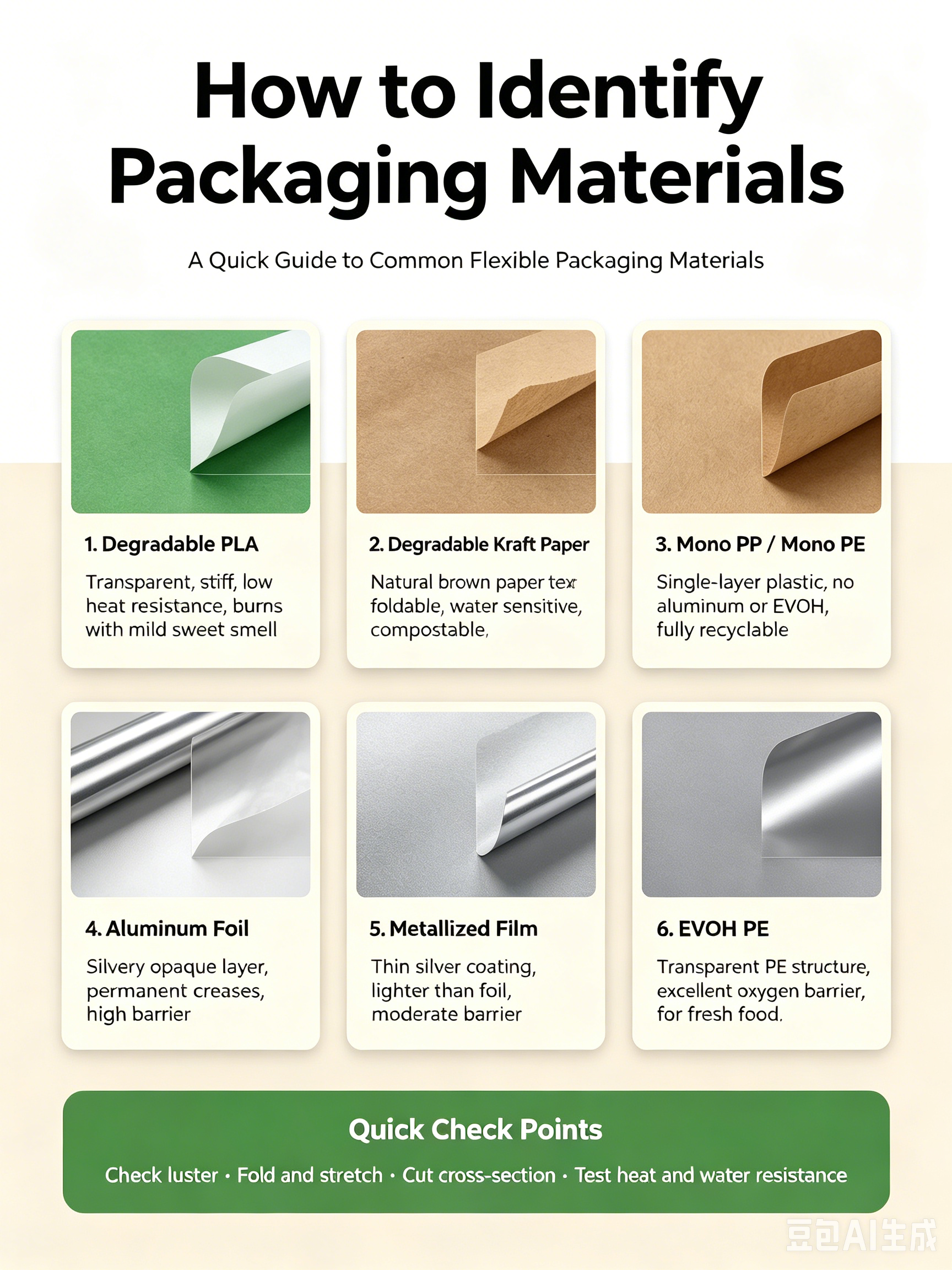
Packaging materials vary widely in texture, function and environmental features. Correct identification helps us classify waste, meet global eco-compliance standards and select suitable packaging for products. Here are simple ways to tell apart common packaging materials:
1. Degradable PLA
PLA is a fully biodegradable bio-plastic made from plant starch.
- Visual & touch: Transparent or semi-transparent, stiff and crisp to touch; feels harder than regular PE plastic.
- Burning test: Burns slowly with a mild sweet plant smell, leaves little ash, and can decompose completely under industrial compost conditions.
- Key feature: Cannot resist high heat; it will deform when exposed to hot water.
2. Degradable Kraft Paper
It is eco-friendly paper packaging coated with biodegradable films.
- Visual & touch: Obvious paper texture, natural brown kraft color; soft and foldable like ordinary paper.
- Water test: Soaks and becomes fragile when meeting water, much easier to tear than plastic composite bags.
- Key feature: Compostable without toxic residues, widely used for food bags and gift pouches.
3. Mono PP / Mono PE (Degradable Single Material)
These are single-layer, recyclable degradable plastic without mixed composite layers.
Mono PP
- Harder, higher temperature resistance; often used for rigid packaging and thick lids.
- Clear or milky white, produces a lighter flame when burned.
Mono PE
- Soft, flexible, stretchable; common in soft plastic film and liquid pouches.
- Stretches significantly before breaking when pulled.
Shared identification point
Both are single pure plastic, no aluminum or EVOH inside, fully recyclable after degradation.
4. Aluminum Foil
It contains thick pure aluminum layer inside the packaging.
- Visual: Silvery opaque surface, obvious metallic luster; folds will leave permanent creases.
- Cutting test: Cut open the pouch, you can see a thick matte aluminum sheet layer.
- Function: Super strong barrier against light, oxygen and moisture for long-term food storage.
5. Metallized Film
Unlike thick aluminum foil, it only has a thin vapor-deposited aluminum coating.
- Visual: Shiny silver surface, lighter metallic glow than aluminum foil.
- Fold test: Creases easily and may turn transparent after repeated folding (the thin aluminum layer falls off).
- Feature: Lighter weight and lower cost than aluminum foil, with moderate barrier performance.
6. EVOH PE
A composite plastic with an EVOH barrier layer inside PE film.
- Appearance: Looks like ordinary transparent PE from outside; no metallic silver surface.
- Professional identification: Requires testing for oxygen barrier performance. It blocks oxygen far better than standard Mono PE.
- Usage: For fresh food, sauce and meat packaging that needs long shelf life.
Quick Summary Tips for Identification
- Check surface luster first to distinguish paper, transparent plastic and metallic materials.
- Fold and stretch to judge softness: paper tears easily, PE stretches, PP stays rigid.
- Cut cross-section to check inner layers: aluminum foil/metallized have silver layers; EVOH PE is all transparent plastic inside.
- Judge eco-properties via heat resistance and degradability: PLA melts at low heat, kraft paper dissolves in water, Mono PP/PE are recyclable single materials.