

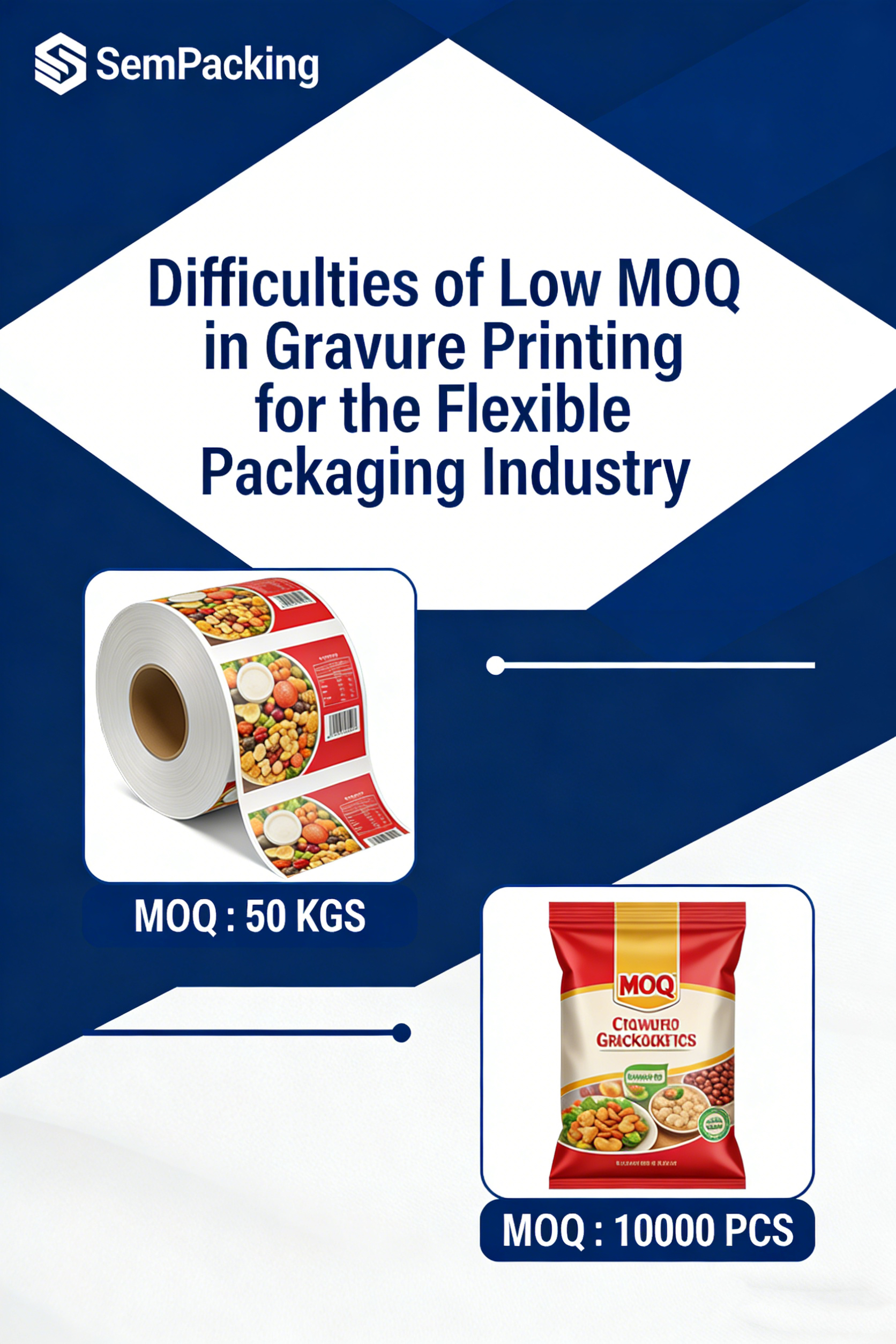
Gravure printing is widely recognized as a core technology in the flexible packaging industry, especially for food packaging, due to its advantages of high color saturation, fine pattern reproduction and stable mass production performance. However, achieving low Minimum Order Quantity (MOQ) in gravure printing has long been a major challenge for manufacturers.
SemPacking, a source factory specializing in food flexible packaging, also faces such difficulties while setting clear MOQ standards: 10000 Pcs for food packaging bags and 50 Kgs for food packaging roll film.
*High Fixed Costs and Low Production Efficiency Caused by the Technical Characteristics of the Process.
Unlike digital printing that can skip the plate-making link, gravure printing requires custom-made engraved metal cylinders for each design, and the cost of a single set of plates ranges from hundreds to thousands of yuan, which accounts for about 15% of the total production cost. For small orders below the set MOQ, the high plate-making cost cannot be effectively amortized, directly compressing the profit space of manufacturers like SemPacking—even if the order is accepted, the unit cost will be significantly higher, making it difficult to achieve cost-effectiveness.
*High Material Waste and Low Production Efficiency in Small-batch Production
Gravure printing machines are designed for large-scale mass production, with a speed of 300-500m/min, which is far higher than small-batch production needs. When producing orders below 10000 Pcs of food packaging bags or 50 Kgs of roll film, the machine needs full setup time (usually 4-8 hours) as large-batch orders, but the output is limited, resulting in low labor and equipment utilization efficiency. In addition, the adjustment of ink, color and machine parameters during the startup process will inevitably produce a certain amount of waste materials, and the proportion of waste in small-batch production is much higher than that in mass production, further increasing the production cost.
*Long Production Cycle of Gravure Printing also Makes Low MOQ Orders Less Feasible
The plate-making link of gravure printing usually takes 5-10 days, which accounts for 50%-60% of the total production cycle. For small-batch orders that often require quick response to market demand, such as new product trial packaging for small and medium-sized food brands, the long plate-making and production cycle cannot meet the timeliness needs of customers, which is also an important reason why SemPacking has to set a reasonable MOQ to balance efficiency and cost.
For SemPacking, as a source factory focusing on food packaging, the set MOQ standards (10000 Pcs for food packaging bags and 50 Kgs for food packaging roll film) are not arbitrary, but a reasonable choice based on the technical characteristics of gravure printing and cost control. Low MOQ orders not only bring cost pressure to the factory, but also may affect the stability of product quality—since the machine needs to be adjusted frequently for small-batch production, it is easy to cause color deviation and other quality problems, which is not in line with the food packaging safety and quality requirements that SemPacking has always adhered to.
In conclusion, the difficulties of low MOQ in gravure printing for the flexible packaging industry are mainly reflected in high fixed plate-making costs, low production efficiency, high material waste and long production cycle. For source factories like SemPacking, setting appropriate MOQ is a necessary measure to ensure production efficiency, product quality and reasonable profit space, while also reflecting the inherent technical limitations of gravure printing in adapting to small-batch, fragmented market demands.